Spring Decisions That Shape Your Silage Success
The decisions you make early in the year will define the success of your silage strategy. From silage quality to sward resilience, every choice has an impact. Kathryn McKeown, Barenbrug Agricultural Account Manager, explains how to get it right at this critical stage.
There’s always the argument, in talking about grass, that it ‘just grows’. But grass that just grows will only ever be good. To be in receipt of excellent grass – in both quality and quantity – you need to manage it.
That shouldn’t be daunting. Observe these four points and you’ll be on the right track.

Daughter Tillers
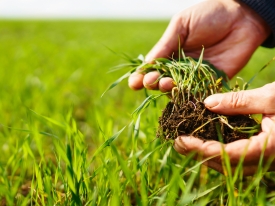
Even if you focus on only one thing, make it your daughter tillers. This is your best route to a resilient sward, come what may.
Think about this: when you cut your silage before the ryegrass heads, you ‘reset’ the plant. It switches back into vegetative growth. In other words, it’s tillering.
A tiller comprises the basal stem, a leaf sheath and up to three growing leaves.
Each one of the original ryegrass tillers in your sward can potentially yield up to three daughter tillers. In turn, each one of those leads to a new ryegrass plant.
Why is that so good? Well, you’re increasing sward density. More tillers means more resilience. And resilience is what every grassland farmer needs to aim for.
Heading and reheading
Emphasising the need to take a cut before the ryegrass heads is important for other reasons, too. As seed heads and stems emerge, grass quality begins to decline. While you’ll be managing your cuts according to different varieties’ heading dates, in different fields, not all the plants in one field will head uniformly. That makes it worth trying to time cuts just right, to minimise reheading and maintain later forage quality.
Forage quality
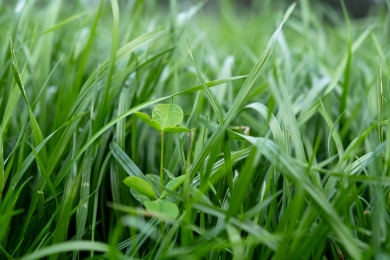
That said, it’s a tricky thing to balance everything. Remember that a single tiller of perennial ryegrass can support only three live leaves at a time. As soon as a fourth leaf appears, the oldest leaf dies.
You can use the three-leaf theory to your advantage: cut at the 2.5-3 leaf stage and you’ll balance both quality (the sugar and nutrients) and quantity (DM yield).
A further rider: how much grass to take (otherwise known as how short you can cut it). Here’s the thing: the growth of the plant’s first leaf is powered by energy reserves stored in the bottom 5cm of the plant (the basal stem). Don’t cut or graze grass too short; it’s vital to leave the growth node of the plant in place to promote quicker re-growth and sward density.
Again, observing heading dates is crucial. Leaf matter and sugar content is at its highest just before the plant is ready to produce a seed head. Planning silage production around this results in high ME and sugar content.
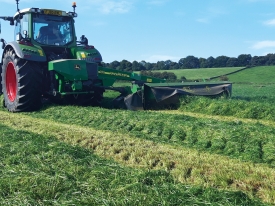
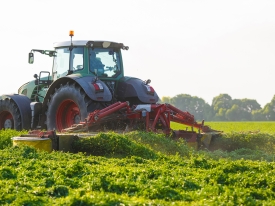
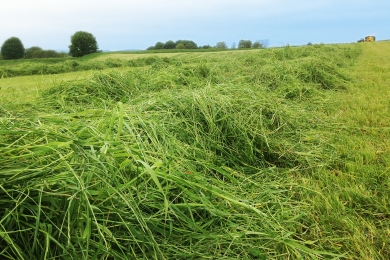
Even the time of day has an influence: sugars are highest early in the day. Early cutting also allows grass to be tedded out to increase DM, while maximising opportunities to harvest and clamp within 24 hours to prevent DM losses and maintain quality.
Silage strategies
The fourth and final point? How to manage silage most effectively on your farm.
I can’t emphasise enough the importance of those last three words: ‘on your farm’.
No two farms will have the same silage strategy. All sorts of factors, from production goals to labour and machinery availability, and soils to local weather patterns, come into play.
That will manifest in three-cut, four-cut, or more-cut strategies: again, according to what works best for you.
But by observing, juggling and respecting the first three focus points, it’s possible to develop the silage strategy that works for you on your farm. And all the time you’ll be recording what you did, when and why, so you’ve hard data and results to feed back into the next year’s plan, whether that’s simply rinse and repeat, or a decision to change tack – for example through reseeding.
Another thing to consider – at least, for inclusion in next year’s plan – is your overwintering strategy too. It can often be beneficial to graze sheep or young stock over silage ground: cleaning the pasture of dead grass, and grass at the bottom of the sward, allows for clean spring growth and a more uniform sward prior to cutting or grazing.
These three months are critical. Make the most of them!