Breeding for a Changing Climate: Rethinking Turfgrass for the Future
Dr David Greenshields, Barenbrug UK
When it comes to meeting the needs of sport and recreation, grass seed breeders don’t just have their finger on the pulse - they are already anticipating how those surfaces will be maintained in 15 to 20 years’ time. That’s how long it takes to bring new cultivars to market, and decades of expertise in the amenity sector helps them continually develop cultivars and blends that meet the challenges turf managers face delivering high-quality playing surfaces around the world.
Over the last 15 years, Hard Fescue has been used increasingly in golf turf management in the UK and Ireland, particularly in medium-fine turf areas, such as fairways on links and heathland sites. This was due to improvements in breeding and an increased focus on sustainable turf management.

With a changing and warming climate, it’s clear to see why its usage has increased as greenkeepers began to appreciate its potential for improving golf courses. Drought in 2018 revealed the fragility of Red Fescues. It caused widespread plant death on fairways across the country, from Sutherland to Kent, the first time I’d witnessed the failure of this grass species in the UK – a species typically known for drought tolerance. In contrast, Hard Fescue - and in some cases indigenous sheep fescue, survived, stimulating greater discussion about its advantages in golf. In less than a decade, Hard Fescue has become a default species for sand-based fairways due to its drought tolerance, low maintenance requirements and tolerance to Dollar Spot. The majority of links courses are now using hard fescue in these areas; 15 years ago hardly any did, and as a result of a successful breeding programme new cultivars are now available as part of Barenbrug’s Sustainable Grass Technology (SGT) concept. Royal Porthcawl, venue for last year’s AIG Women’s Open, was a notable early adopter that has become a showcase for successful, sustainable fairway management.
Is Species Change Inevitable?
As our climate changes, we may need to look at other turfgrass species, particularly in the South East of England, which faces the toughest associated challenge of water scarcity. Could our most widely used turfgrass species, Perennial Ryegrass, begin to give way to alternatives in summer and even winter sports? With further changes in climate, water availability, and pesticide legislation, what might those hardy and sustainable options be, and how open is our industry to change?
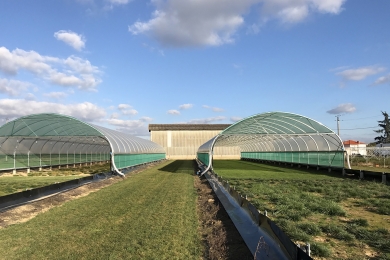
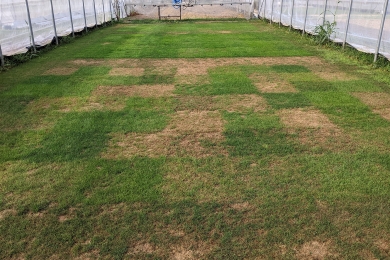
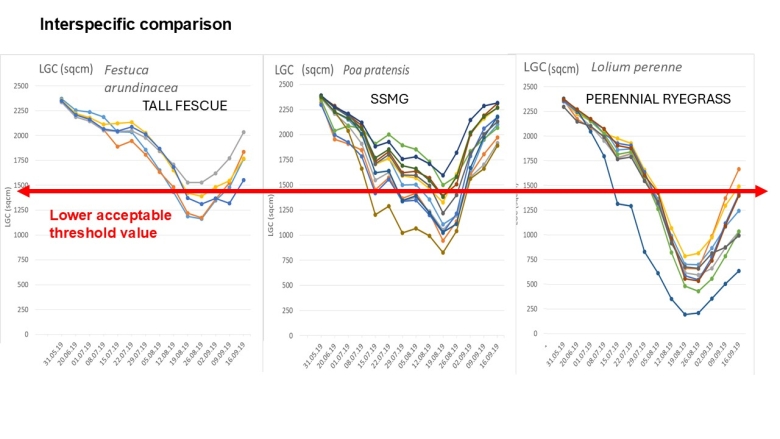
Barenbrug has already conducted testing to see how it might respond. Drought trials of multiple cultivars of each species were run in rain-out shelters – used to simulate drought conditions, at Landlab in Northern Italy. Perennial Ryegrass suffered a lot more than Tall Fescue and Smooth-Stalked Meadowgrass during the drought stress. A red line ‘threshold value’ for visual merit was then determined by a large social experiment. A range of turf industry professionals, from Grounds Managers to specifiers and turf growers, were asked to score a series of pictures of turfgrass from 1-5, with 3 being ‘acceptable’. From this experiment, a threshold was reached. Some varieties of Smooth-Stalked Meadowgrass and Tall Fescue never fell below the threshold, whereas all Ryegrasses did. Data aids us in continuing to meet end-users’ expectations, but does not address the views of players, spectators, TV audiences, venue owners, and sporting governing bodies.
The Pressure's On
Disease is a major factor associated with climate change, particularly Dollar Spot and Grey Leaf Spot currently in the UK. A subtle change in mean temperature can send populations of pathogens soaring. We can look to USA for examples of how plant breeding has helped to address both of these diseases, which have been commonplace for the last few decades.
We are now seeing Grey Leaf Spot across stadia in the south of England, despite it only being first identified on UK pitches in 2020. Breeders are firefighting to identify ryegrass cultivars that can tolerate this pathogen in the UK climate and help this species stand up to the rigours of our winter. Varieties like Amiata and Barprium in the Elite Defence seed blend are coping well for the time being, whilst breeding teams are working intently to screen new material with stronger tolerance and exceptional winter performance.
Smooth-Stalked Meadowgrass could also offer a solution as it is not typically a host for Grey Leaf Spot pathogens, but fast-establishing ryegrass is required for the renovation of hybrid pitches. Might our industry need to adapt its strategy in this regard?
It is likely that we will need to consider alternative turfgrass species in our driest regions, and for surfaces without access to adequate irrigation. Through continual agronomic observation, focussed breeding programmes and feedback from turf managers, we’re doing everything we can to ensure that playing surfaces continue to meet the demands of sport.
Related Information

Elite Defence
-
Proven high disease tolerance to Grey Leaf Spot (GLS) – Amiata, Barprium and Barorlando
-
Increased tolerance to Drechslera Leaf Spot and Brown Patch Rhizoctonia
-
High performance and wear tolerance with top-ranked cultivars Barzico #3 and Barbasten #6 BSPB Turfgrass Seed