Why Choose All Hard Fescue For Golf Fairways?
Over the last 15 years, the species hard fescue has been used increasingly in golf turf management in the UK and Ireland, particularly in medium-fine turf areas such as fairways on links and heathland sites. This is due to improvements in turfgrass breeding and an increased focus on sustainable greenkeeping, especially after the severe summer heat and drought stress of 2018.
As new varieties of hard fescue hit the market, it seems appropriate to take a fresh appraisal of the species to fully appreciate its potential for improving golf courses.
Hard fescue can be categorised as a fine fescue, which in terms of turfgrasses can be narrowed down to a group of five species and sub-species - the well-known red fescues (slender creeping, Chewings and strong creeping) and sheep fescue. “Fine fescues” shouldn’t be confused with the (dramatically different) species tall fescue – a much broader-leafed grass used extensively for sports and landscape turf (as well as golf) in the USA and other parts of Europe (sporadically in the UK).
In terms of further classification, its nomenclature has been a strongly debated subject; it was once called Festuca duriuscula, then assigned Festuca ovina var. duriuscula L.Koch, then F. longifolia Thuill., before F. brevipila Tracey and F. trachyphylla Krajina. Both F. brevipila and F. trachyphylla are in widespread use today.
Regardless of its binomial name, the important question to answer is why should it be considered for use on a golf course?
Drought tolerance
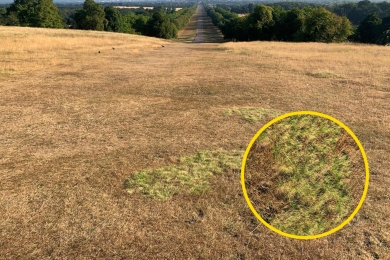
Drought tolerance is likely the single biggest stress factor that has resulted in increased hard fescue use on golf courses in the last few years. The 2018 heat and drought caused widespread plant death on fairways, and perhaps surprisingly was the fragility of red fescues. By contrast, hard fescue (and in many cases indigenous sheep fescue) survived well (see Figure 1). Variation in stomatal density between fine fescue species (lower in hard/sheep than red fescue) may be one reason for this difference in stress tolerance.
This phenomenon mirrored Barenbrug trials, which had been ongoing in parts of Europe for several years, and resulted in the launch of Sustainable Grass Technology (SGT) mixtures in 2020. Drought (and heat) tolerance is one of the four pillars of the SGT concept.
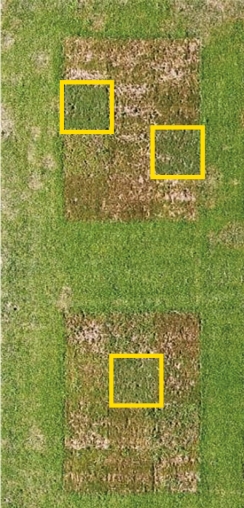
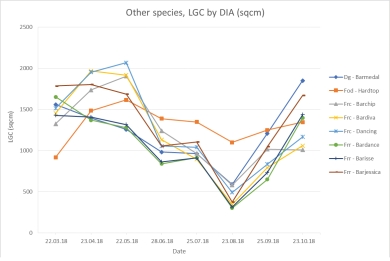
Data from Landlab in Italy during the 2018 summer exhibits the very different response to heat and drought of hard fescue, compared to red fescues - see Figures 2 and 3.
Overseeding programmes, utilising the better survival rates of hard fescue in SGT Rye Fairway (parkland/heathland) and SGT Fine Fescue (heathland/links) should help future-proof fairways for a similarly destructive drought moving forward.
One further advantage relating to water-use; whilst hard fescue is often thought of as having slightly slower establishment times than red fescue – in the field this doesn’t always ring true. The seed size of hard fescue is ~30% smaller than red fescue, and in a sandy fairway environment this often results in quicker germination due to less water imbibition being required.
Low maintenance
Another significant difference between hard and sheep fescues in comparison to red fescues is their ability to thrive in (free-draining) areas of low fertility and poor soil. This well-documented trait dictated their widespread usage as a landscape turfgrass or in golf roughs before advancements in turf quality shifted their use to regularly mown areas.
In a 1997 study, Bourgoin reported hard fescue as having higher nutrient-use efficiency (NUE) than the red fescue sub-species and noted all fine fescues exhibit little response to increasing N inputs above their standard requirements. Not surprisingly therefore, hard and sheep fescue grow slowly and likely produce thatch less aggressively than the red fescues, which has implications for use in fairways and roughs – areas of the golf course that receive less nutrition and infrequent mechanical disturbance. These points link to two of the other four pillars of SGT – low biomass production and nutrient use efficiency.
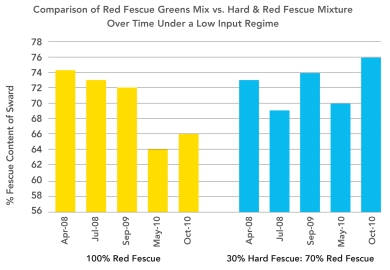
An extensive trial in conjunction with the STRI that looked at grass mixture performance under “standard” green maintenance (4mm mowing height, higher nutrition, verticutting) and “low input” maintenance (6-7mm mowing height lower nutrition, brushing) highlighted these findings. Under “low input” parameters a seed blend of 30% hard fescue, 70% red fescue outperformed a more traditional option of 100% red fescue (see Figure 4). The mix with hard fescue maintained higher proportions of total fescue (i.e. less Poa annua invasion) during the long-term trial.
Disease and pest tolerance
Hard fescue has strong disease tolerance in general as a species, with expected variation between cultivars.
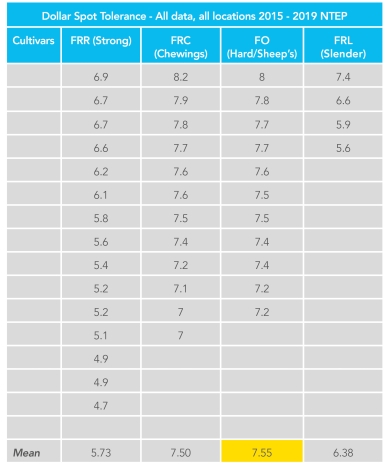
Of particular interest is its dollar spot tolerance, rated "good to excellent” in a recent extensive scientific review in the USA (Patton et al., 2022) published by Purdue University and encompassing NTEP trials of the last 20 years amongst other sources. By contrast the other fine fescue species are rated either “poor to fair” (strong and slender creeping) or “fair” (Chewings and sheep), which highlights hard fescue as a critical component for fairway overseeding in the UK and Ireland with raised dollar spot concerns (particularly with C. homeocarpa pathogen prevalent in this region). It also highlights a significant difference between hard and sheep fescue. Data from the latest NTEP completed trial is presented in Figure 5.
In the same review article, hard fescue is rated “good to excellent” for red thread (along with sheep, and better than the red fescues) and “good” for snow mould (best rating among the species). Additionally, the latest completed NTEP trials also highlight hard fescue as being the best fine fescue for leaf spot pathogens.
The overall disease tolerance of hard fescue marks the fourth and final pillar of SGT, and is a major factor in the species inclusion in this Sport Range concept.
Widespread anecdotal evidence is now forming (with increased hard fescue use) that some protection against insect pests and also worm-casting is a further benefit of this turfgrass species. It is hypothesised that either the abrasive texture of the leaves or possibly a higher lignin content below the surface reduces insect (egg-laying of cranefly and resulting leatherjackets) and worm activity.
Other differences between hard and sheep fescue
It is fair to say that hard and sheep fescue are often very similar grasses in many ways, not least in their physical appearance in turf. They can often be misidentified and confused for one another, even when it comes to the grass seed market. For example, an older variety Bornito is regularly sold as sheep fescue, when it is, in fact, a hard fescue.
Although morphological differences can be difficult to spot, genetics can easily identify the two species – which interestingly have different ploidy (numbers of chromosomes). Sheep fescue (Festuca ovina) is a tetraploid, with 28 chromosomes, whereas hard (Festuca breviplia) is a hexaploid with 42.
Hard fescue is preferred by grass breeders for many reasons, and far more commercial varieties are available of this species. There have been very few sheep fescues bred and trialled in the last 25 years, whereas new and improved hard fescue cultivars are coming to the market regularly. One reason for the preference is seed yield and production, but hard fescue has several other advantageous traits to consider.
As already mentioned, disease tolerance can differ, with dollar spot being a notable point for hard fescue. Sheep fescue has lower wear tolerance than hard, particularly in comparison with newer varieties, and hard fescue is generally given the edge with regard to shade tolerance (Braun et al., 2020). These facts all point to hard fescue being more applicable for golf course use than sheep fescue, especially in areas with traffic or light deficit, or dollar spot concern.
New cultivars in Barenbrug Sport Range
Breeding advancements in hard fescue are moving the species forward quickly in terms of turf quality, disease tolerance and other important traits. In 2025, Barlegant joined the Sport Range in SGT Fine Fescue and a recent cultivar from USA, Beacon, was reintroduced to the same mixture.
Barlegant offers a new standard of turf quality for the species and is listed as the new #1 cultivar in Table L6 of Turfgrass Seed 2025; Beacon is not far behind in the #2 position.
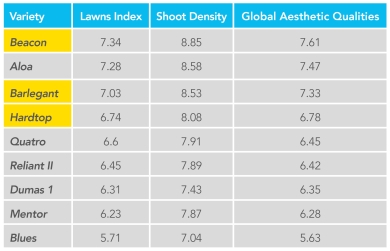
In the GEVES Turfgrass List (Figure 6; independent trials in several European countries), Beacon is #1-ranked for hard and sheep fescue for a range of traits, including lawn index, global aesthetics, shoot density, wear tolerance and red thread tolerance.
The introduction of these two new cultivars cements SGT Fine Fescue in its market-leading position for overseeding links and heathland fairways.
Conclusion
In conclusion, it can be seen that hard fescue fairway overseeding has increased dramatically in the UK and Ireland in recent years, particularly in response to the 2018 drought. With advancements in plant breeding, this species promises further benefits moving forward, with respect to the other pillars of Barenbrug’s Sustainable Grass Technology (SGT) concept.
Disease tolerance (particularly dollar spot) sets hard fescue apart from other fine fescue species (including sheep fescue), and makes this species a truly hardy and sustainable survivor with climate and environmental issues in the present and future.

References
Bourgoin, B. (1997). Variability of fine-leaved fescues (Festuca spp.) grown at low nitrogen levels. International Turfgrass Society Research Journal; 8: 611-620.
Patton, A., Braun, R., Barnes, M., Nelson, K., Reiter, M., Watkins, E., Koweleski, A., Koch, P. & Murphy, J. (2022) Fine fescues: Understanding the differences. Horticulture and Landscape Architecture, Turf-63-W Purdue Extension, online.
Braun, R., Patton, A., Watkins, E., Koch, P., Anderson, N., Bonos, S. & Brilman, L. (2020). Fine fescues: A review of the species, their improvement, production, establishment, and management. Crop Science; 60: 1142-1187.
Related Information
SGT All Hard
-
SGT technology offers outstanding turf performance with reduced water, fertiliser and chemical inputs
-
An overseeding mixture of three hard fescues to increase this species composition in sand-based fairways
-
Hard fescue exhibits increased drought tolerance over red fescue and higher Dollar Spot tolerance than other fine fescues, including Sheep fescue
SGT Fine Fescue
-
SGT technology offers outstanding turf performance with reduced water, fertiliser and chemical inputs
-
An innovative mixture of fine fescue species
-
Three #1-ranked cultivars for lawn/fairway use
SGT Rye Fairway
-
SGT technology offers outstanding turf performance with reduced water and chemical inputs
-
Drought and disease tolerance, and superior colour
-
Barprium for fine-leaf grass with proven capacity for nitrogen-use efficiency