Alford Fields Farm Testimonial - Bright Maize
For pastures new…
“Show me the cow and I’ll show you the pasture.”
Few people get the chance to start over in farming, yet nearly 30 years after taking on her father’s tenanted Somerset farm, that’s effectively what Catherine Pickford did – moving to a new, larger holding in pursuit of her low-input dairying ideal.
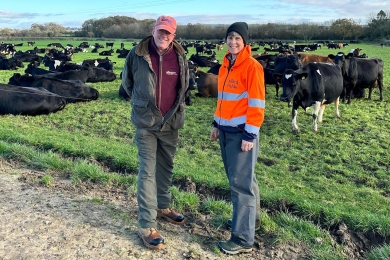
But an effective low-input system needs robust, joined-up thinking. Catherine’s ideal cow – a New Zealand Friesian x Jersey, with its ‘compact’ 500kg footprint – chases efficiency rather than outright yield. Meanwhile, her milk buyer – local cheesemaker Barber’s – expects exacting butterfat and protein to produce its PDO-accredited cheddar.
So, in moving the ten miles from the old 280-acre holding to the ‘new’ 500-acre Alford Fields Farm at Lovington, not only did Catherine seize the opportunity to install a new 40/80 swingover parlour, permitting a return to twice-daily milking, but also had to face up to the reality of a whole-farm reseed to meet the demands of both cows and buyer.
Building resilience from the ground up
Catherine defines herself as a ‘grass manager’ with eyes on the cost. She doesn’t chase yield, rather efficiency. Resilience too: future-proofing the farm, not only against rising costs (home-grown grass will always be the most inexpensive feed on a dairy unit) but also changing weather patterns. The farm sits on sandy loams and clays; good for maintaining soil moisture when it rains, but problematic in times of dry.
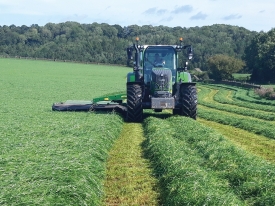
Back to the cow. Catherine’s low-input, compact cow needs reliable, resilient and persistent grazing to produce its 5,500l/yr yield. The move also allowed her to bump up numbers by a third, to 400. High-maintenance ryegrass wasn’t the answer; instead, Bright Maize’s grass specialist Mike Sims suggested mixes based on rich proportions of tall fescue and cocksfoot, alongside diploid and tetraploid intermediate and late PRG drawn from Barenbrug’s extensive range of varieties. This solution would be well-suited to building pasture resilience and the ability to deal with drought conditions.
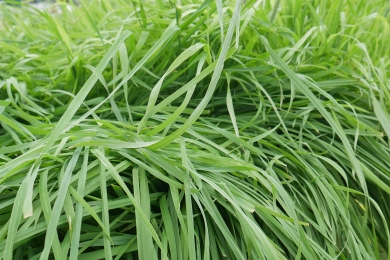
Choosing the right grass varieties
Deep-rooting cocksfoot, despite its drought tolerance, fell out of favour after suffering from a reputation for low feed quality and tussocky growth habit. But its growth characteristics – providing a reliable early bite – coupled with modern varieties, such as Barenbrug’s Archibaldi, that have improved palatability, yields and feed quality, have seen it spring back into contention.
Likewise, tall fescue. With a root system that often reaches more than a metre’s depth, fescue’s able to tap much deeper soil moisture reserves; what’s more, during severe drought it will enter a rapid dormancy, conserving energy and resources until conditions become more favourable. Thus fescue will often be the first species within a mix to ‘green up’ again following a spell of drought.
Reducing inputs while maintaining performance
Initial reseeding mixtures often didn’t include clover to allow for weed control during establishment. But now, eight years since the move, dense swards ward off the threat of weeds and just two of the farm’s grazing paddocks are left to reseed with the revised mixture, which now includes timothy (to leverage an earlier turnout) and both red and white clover.
That’s because Catherine’s still chasing her low-input target: since including clover, she’s been able to slash nitrogen applications from 50kg to 30kg per hectare. That’s a cost-saving right there, says Catherine – yet these mixtures are nevertheless yielding well: 13 t/ha in 2024, which dropped to 9 t/ha after the effects of 2025’s reduced spring rainfall.
Investing in people as well as pasture
Catherine’s no-nonsense approach to modern dairy management goes beyond her pursuit of low-cost, low-input systems. She’s also focused on nurturing the next generation of dairy farm talent: her herd manager is engaged in a steady process of building equity in the farm by owning a proportion of the cows, which Catherine then rents back from him. He’s not the only one to benefit from Catherine’s encouragement, as another full-time staff member has visited New Zealand on a fact-finding mission, while the whole five-strong farm team leans in to regular business sessions to discuss improvements, observations and suggestions.
It should be no surprise that Catherine’s ‘elegant and simple low-cost system’ saw her clinch the Farmers Weekly Dairy Farmer of the Year award in 2022, with judges concluding ‘the industry has much to learn from people like Catherine’.
Explore more of our agricultural grass varieties.