Black-Grass Control: How Herbal Leys and Livestock Can Help
Frustrated with black-grass control and determined to diversify his farm’s income stream, third-generation Suffolk farmer Mike Morley made a bold move: he brought back cattle on his 90ha farm at Bradfield St Clare.
The last time cattle grazed the fields at Bishops Farm was during the 1980s. Since then, Mike had pursued a pure arable rotation, but with an increasing focus on more sustainable practices. Looking to adopt further basic regenerative principles, Mike decided to go back into livestock.
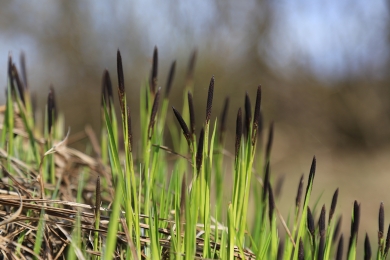
“The ‘classic’ regenerative pasture being a herbal ley, I realised that this could also help solve or reduce our black-grass problem,” he says. “This heavy land makes the farm a prime site for black-grass. We’d been spending a fortune on herbicides.”
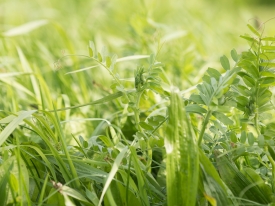
The dense, fast-growing, multi-species sward of a herbal ley can comfortably outcompete emerging black-grass seedlings, while grazing – or cutting – prevents survivors from heading, thus preventing further seed return.
Data from AHDB suggests that a four- or five-year herbal ley can reduce the viable black-grass seed bank in the soil by over 99 per cent.
Mike didn’t embark on his restocking journey alone. He turned to a service offered by specialist livestock co-operative Anglia Quality Meat (AQM), which works with farms of all sizes to support them with livestock production. The level of input is determined by the customer, within broad bands that range from simply sourcing weaned calves, through to a near-turnkey service that covers the whole process from selection to marketing.
Key to making this work are the partnerships that AQM has developed to ensure customers always have access to the necessary expertise, insight and advice. “Restocking after a period without livestock ‘in the mix’ can be a daunting prospect,” acknowledges AQM’s development manager, James Doel.
Peer-to-peer
“A lot of farms simply don’t have the institutional livestock knowledge anymore – that experience has left the farm. So they need to find a good source, but no-one likes to be ‘sold to’ in search of advice, which is why the partnership model works: it’s like a peer-to-peer support group.
“We don’t claim to be a jack-of-all-trades, advising on everything livestock; instead, our partnership model makes it very much easier to call in the experts when customers need it.”
One such partner is Barenbrug, whose in-depth understanding of what makes for the best grass for any situation, be it dairying, beef, or environmental purposes, has been highly valued by AQM customers – particularly those who, like Mike, have been more focused on arable than grassland agronomy.
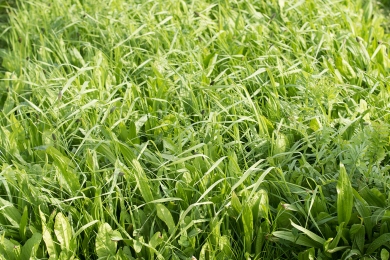
Barenbrug’s Emily Abrey says the farm’s Hanslope Clay soils now support a robust herbal ley comprising around 20 species. “Mike’s put about 10ha into herbal leys, which he intends to keep for as long as the clover survives. He practises a relatively low stocking rate, but often paddock grazes to ensure good utilisation.
“Herbal leys aren’t just good for grazing, you can take a punchy haylage from them too. Mike cuts early, as the head emerges, which gives a 14% protein level. That’s not far off standard calf pellet protein content.”
But just as important is what’s going on beneath the soil surface, says Mike. “A herbal ley really does make a difference to field drainage,” he confirms, “especially when the mix contains a really deep-rooting species like chicory.
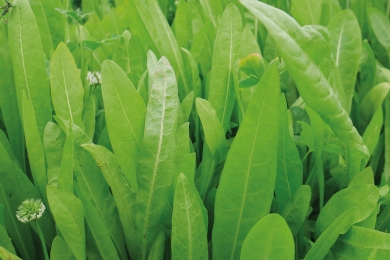
“It’s no exaggeration to say that chicory’s the ‘green subsoiler’ – it’s doing the job of a flatlifter, without diesel,” he points out.
Mike also reveals that soil organic matter has risen two per cent since the herbal leys were put down five years ago, following more than 40 years in arable production. “We didn’t set a target for SOM but that’s still an impressive increase.”
Mike’s expectation was for the herbal leys to act as the main source of feed, whether grazed or as haylage, with supplemental feeding as required. Hereford/Angus dairy calves are bought in from another AQM unit – typically 30 at a time – at 3-5 months. Initially fed ad lib hay, with a 2kg/head pellet ration, the haylage (which is more acidic) is only gradually introduced as the calves’ rumen becomes fully functional. It’s a good system: AQM sets a target of 1kg/day (lifetime average) for liveweight gain; Mike regularly returns 1.1 or even 1.2kg/day LWG.
Data analysis
Mike is signed up to AQM’s Plus package, which is delivered with input from another AQM partner, the data specialist AgriWebb (recently acquired by genetics giant URUS). Mike’s cattle are weighed every six weeks during winter and every three months while out at grass. Captured in the cloud, the data’s analysed by the AQM team who then come back to Mike with observations or advice to ensure the cattle are realising their full potential.
“For the farmer, it’s perfect – they can be as much or as little involved as they want, when it comes to analysis,” explains James. “For us, the benefits are legion: much better forecasting capabilities for a start, which makes marketing more efficient, but also the historic data we’re collecting. Production figures, kill out percentages, overall performance – this is all incredibly valuable data, which helps us to further refine what we can offer to customers, as well as our partners throughout the supply chain.”
For marketing, data analysis is matched by on-farm visual assessment to select animals that meet the minimum target of 600kg liveweight when between 18-20 months.

‘It works’
Mike’s satisfaction with the system carries through to the bottom line: his margin is ‘between £200 and £300’ per head.
“People say to me about bringing cattle back on-farm, ‘You’re mad!’. But it works. And when we’re getting squeezed tighter and tighter on arable margins, we need to see more of this in the East of England: livestock across more farms. It works.”
Commander - Chicory
-
A mineral-rich herb with long taproot capability, aiding drainage and soil structure
-
COMMANDER produces significant yields of high protein forage