Mixing It Up: Why One Grass Seed Mixture Won’t Fit All
How to choose the best grass seed mix for your farm. Learn strategies for different soil types, improve pasture resilience, and boost yields year-round.
Do you remember the name of the last grass-seed mixture you sowed? Don’t worry, it’s not a trick question. But we're keen to know what you remember about it. In particular, do you recall if it was the same mixture as you’d bought before? For another field?
Whether you can answer ‘yes’ or ‘no’ to the above is not important, but we hope you’ll read on – because we think you could be getting even more from your grass if you’re prepared to think a little differently about the strategy behind it.
That’s because while we often talk about ‘grass into gold’ – the sheer magic that ensures lush, green grass transforms into litres of milk and fabulous fatstock – we don’t subscribe to the view that everything green is gold. Some greens are better than others.
To get that better grass growing on your farm needs a more nuanced approach, which starts with getting a better understanding of what you’re farming. By that, we mean your soils.
When it comes to soils, the UK has remarkable soil diversity for its size. That variability – as you probably know – plays out even within a farm, and often within a field. Think of the shallow-soiled corners of the farm that are the first to burn off during a drought. They’re probably matched by wetter fields that are always the last to stock in spring and the first to de-stock in winter. Less likely across a ring-fenced farm, but certainly possible if you’ve different parcels of land, are the differences in pH and nutrients.
Expecting all these soils to provide consistent grass performance? That way lies madness. You’re on a hiding to nothing by using high-yielding varieties (in other words, varieties with high demands) on land that simply can’t support them.
We call these the ‘special cases’. It’s a satisfying challenge to think not about how you can ‘farm out of a can’, pursuing a uniform approach in an attempt to coax performance out of all fields, but instead to piece together a ‘patchwork quilt’ of species, varieties and mixtures that will support your grass strategy in a more resilient, more sustainable fashion.
Reliable Ryegrass
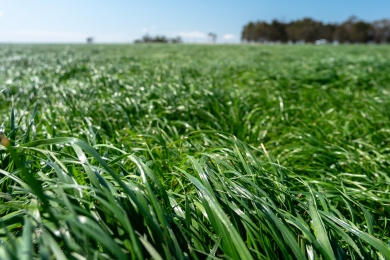
No, we're not advocating a wholesale switch away from ryegrass. Italian, perennial and hybrid ryegrasses all have roles to play in UK grass strategies. Fields that you know to be highly productive should be planted with ryegrass.
In fact, 2025 with its dry spring and summer, has given us a good insight into the potential for grass strategies that include hybrids too. Their rapid early-season growth and high yield potential, combined with persistence and grazing tolerance, could become increasingly valuable when rainfall comes in short, sharp bursts rather than longer, steady spells. Plus there’s the attraction that hybrids in the sward increase palatability for dairy cattle, in turn supporting higher DM intake and thus lifting milk yields at grass.
Having said that, your diploid varieties – which generally display a higher tiller density – will perform slightly better in dry weather. It’s a prime example of why you should seek out that diversity in the sward – something for every outcome.
But even a hybrid ryegrass is still ryegrass: shallow roots see it struggle in the dry. You might have to accept that some of those ryegrass fields, so productive under typical rainfall, might have to be put ‘out of use’ if there’s a dry spell through July and August.
Fear not, because your new grass strategy is built upon the patchwork quilt: if ryegrass has effectively gone AWOL, you can turn to something else.
Multi-species
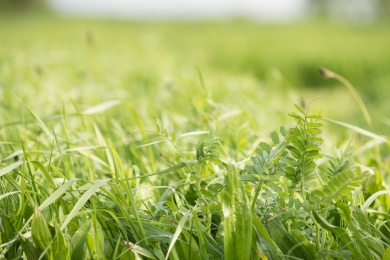
You might have heard us talk about Barmix. Originally we developed it to help upland farmers with some of their typical challenges, such as thin, shallow soils. But its constituent species – cocksfoot, timothy and tall fescues, over a mixed diploid/tetraploid ryegrass base – take other challenges in their stride. Nice, strong, deep roots, with access to water lower down in the soil profile, keep that sward productive under lower rainfall.
Another route to pursue is those speciality crops, such as lucerne and chicory. Why? It’s all about the taproot: lucerne’s roots often grow to a depth of 2-3m and as much as 15m, in search of water and nutrients. Chicory will grow to 3m. Drawing on deep water reserves allow both crops to not only survive the dry but also allow continued grazing.

Farm Fodder Flow
Your new patchwork quilt of species, varieties and mixtures will demand a change in how you moderate your expectations. Timings might change. Silage might be cut earlier. You might consider how you can integrate dry fodder (hay, haylage) into your flow, to further increase resilience and to extend the flexibility offered by field and sward diversity.
And yes, it may take a little more work than sticking with a one-size-fits-all approach. But when it comes to resilience, sustainability, profitability and potentially reducing reliance on bought-in feeds, we have little doubt it’s work that will be well worth the effort.
Related Information

Barmix
-
A multispecies grass mix, providing benefits from diverse grass rooting structures
-
Tolerant to periods of dry conditions
-
For cutting & grazing