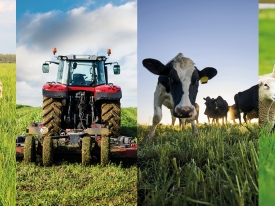
Spring Into Action: Building a Smarter Grassland Plan
The transition from winter to spring means your grass plan is closer to being put into action, says Barenbrug’s David Linton.
I make no apologies for the fact I’m always talking grass. But that’s because it’s important to get things right, to the same degree that it’s all too easy simply to take grass for granted.
Yes, of course grass does ‘just grow’. Anyone who’s ever struggled to keep a lawn under control knows that. And there’s a good reason why we have the saying about ‘letting the grass grow under one’s feet’…
But the other side of that idiom? Don’t waste time or hesitate before you act – which is where I’m headed today. Don’t let the grass grow without having a plan. Today, it’s time to make that plan.
Since the start of 2026, we’ve been using our blogs to talk about the importance of resilience, persistence, and the focus points to consider in good grassland management. Now that spring’s upon us, it’s time to dust off and review last year’s grassland plans – or start afresh with a new set.
Production Goals
Again, no apologies if you’ve heard me say this before: defining your production goals is the single most crucial concept in devising a successful grassland strategy.
No two farms are the same. You can’t cadge production goals from another farm, still less ChatGPT. Only you know how many ‘units’ – litres, kilos, stores – you need to stay profitable, to stay farming. Know that figure, and you’ve the foundation of your plan.
Farm Fodder Flow
It’s important to know these principles and always have them to the front of your mind when considering grass production and utilisation.
If your production goals define what you want to achieve, then farm fodder flow (FFF) helps you quantify the connection between your farm’s productive capacity and your animal’s dietary requirements.
At its most basic level, FFF helps to address and mitigate concerns about becoming too reliant on home-produced feed, while reducing the need to (often expensively) fill the gaps in the feed programme with bought-in concentrates.
It’s not just about costs, or indeed the perceived benefits of home-produced feed. Done well, it can also help smooth your labour requirements throughout the year.
Your biggest question will be this: does your livestock class (hill sheep, fat sheep, 20-litre cows or 45-litre cows, etc) and quality adequately match your available grass? Will your peaks in demand match the peaks in supply?
Don’t worry if you see a mismatch between the supply curve and the demand curve. It’s why we cut silage. But then again, silage isn’t the only option. Perhaps you could do better than silage? Perhaps you could do better silage?
Improve the Flow
FFF isn’t just about quantities. It’s about quality too. One immediate change you can make would be to increase the number of cuts. To move from a two-cut strategy to a four-cut approach is the best example – offer cows silage from a four-cut system and they’ll not only display higher DM intake, but the benefits that come with that such as increased milk yield and higher butterfat and protein.
Improve Selection
OK, so changing to a four-cut system might entail reseeding some fields with a newer, four-cut capable variety. Which ones will you select? This is where you can practise grass indexing: identify the fields that are nearing the ends of their productive lives (and therefore ripe for reseeding), as well as those that are likely to be the most efficient at filling the clamp.
Another application for indexing is in better understanding the capabilities and performance of the fields at your disposal. Unless you’re very lucky, you’ll have certain fields on your farm (the field names might be a clue – Starvall, for example) that thanks to poor soil or drainage, stubbornly refuse to show benefit from the resources applied. So concentrate your efforts on fields that you know can be improved, and whose performance can be sustained.
Think Different
What about those alternatives? Can you fill in more of the demand curve with (home-grown) silage alternatives?
Yes. Don’t be afraid to think beyond silage. Short-rotation options might include winter brassicas, for example, or even Italian ryegrass and forage rape. What’s key about these is the flexibility they lend to your plan – they’re easy to switch in and out. They also provide a different plane of nutrition, which – depending on your production goals – might be the ‘missing link’ in achieving your unit’s potential.
Weather
You can’t plan for it. You can’t plan without it. We’re in Britain, for a start. The added complication is that climate change is happening.
What you can do is to make every effort to make your plan resilient. It doesn’t matter if you have to change tack. What does matter is that you’re able to, because your plan is flexible enough to allow it.
What does that mean in practice? Everything we’ve just talked about. Confident and competent planning around each element is what will see you through.
For example:
- in using your grass indexing to prioritise field use, maintenance and reseeding, you can make a fundamental commitment to ensuring a renewal/reseeding rate of 10-15 per cent of your grassland each year.
- In turn, that allows you to select newer varieties that permit more varied strategies (such as four-cut silage) or to mixtures that will stand up better to extended dry periods.
- Move away from uniform PRG and towards a patchwork approach: deeper-rooting species for lighter soils, able to see the pasture through a dry spell, saving the heavier soils for diploid and tetraploid mixes – these you can shut off during a summer dry spell, without affecting production goals.
- Then there’s the multi-species approach, offered by something like Barmix. Originally we developed it to tackle upland farming challenges, such as thin, shallow soils. But its constituent species – cocksfoot, timothy and tall fescues, over a mixed diploid/tetraploid ryegrass base – take other challenges in their stride. Strong, deep roots, with access to water lower down in the soil profile, keep that sward productive under lower rainfall.
- Practise that forage rotation. Bring alternatives into mix: different nutrition, weed control, break crop, soil health. Not only does it help weather-proof your grassland plan, but it adds those all-important different dimensions that can even help you realise production goals you might have thought were impossible.
In short, there’s a plan for your farm. You just need to discover it.

Barmix
-
A multispecies grass mix, providing benefits from diverse grass rooting structures
-
Tolerant to periods of dry conditions
-
For cutting & grazing